
Loading article…
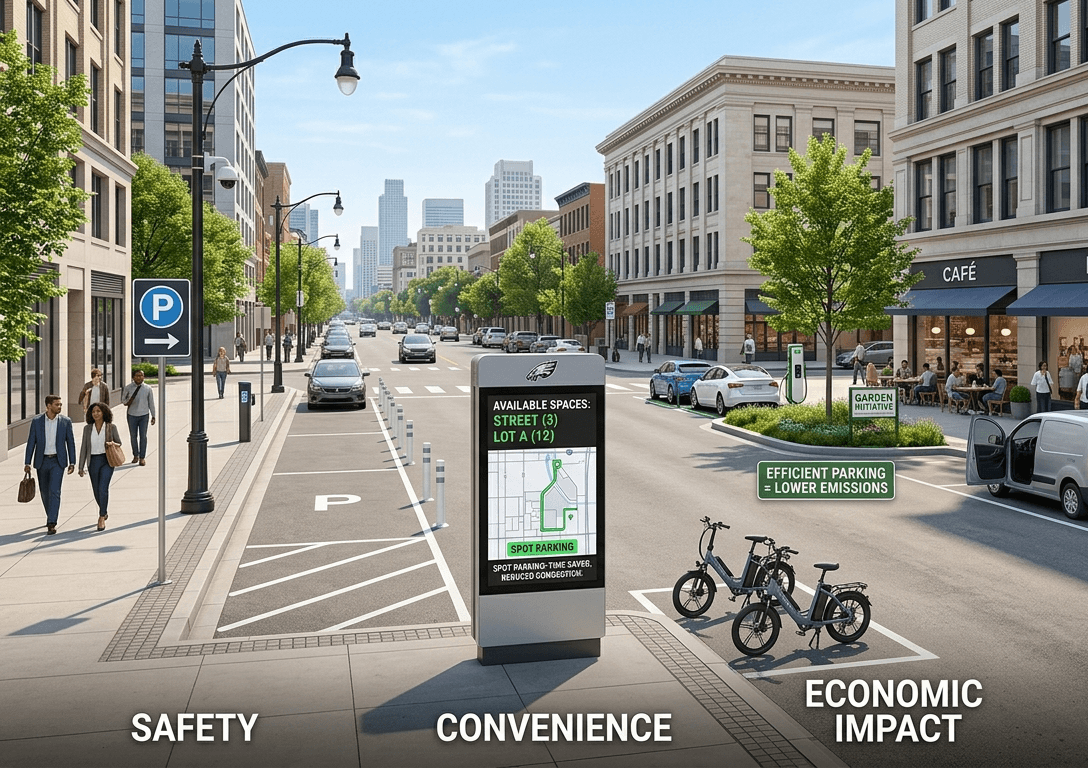
The Overlooked Infrastructure Secret to Safer Streets, Vibrant Local Economies, and Sustainable Modern Cities
Published January 21, 2026
Parking may not dominate headlines, but its influence shapes how safely people move, how efficiently cities function, and how sustainably communities grow.
When most people think about urban infrastructure, parking rarely comes to mind. Yet this overlooked system quietly influences everything from public safety to local commerce, environmental impact, and quality of life. As cities grow denser and mobility patterns evolve, the case for intelligent parking management has never been stronger.
Understanding why organized parking matters—and how modern technology transforms these operations—reveals opportunities that extend far beyond finding an open space.
Parking touches nearly every aspect of urban life, creating ripple effects that compound across safety, economics, and environmental sustainability. The difference between chaotic and well-managed parking isn't just operational—it's foundational to how cities function.
Well-lit, clearly marked parking areas do more than improve visibility; they deter crime and reduce the likelihood of accidents. Disorganized or overcrowded parking environments create confusion, increase collision risk, and often push drivers toward poorly monitored or unsafe alternatives.
In high-density or underdeveloped areas, the stakes are even higher. A lack of structured parking can amplify existing safety concerns, turning a routine activity into a potential liability. Order, in this context, is not cosmetic—it is protective.
Parking plays a quiet but decisive role in local economies. Accessible, well-managed parking encourages customer turnover and increases foot traffic for nearby businesses. When parking is scarce or chaotic, potential customers are more likely to abandon their visit altogether.
The implications extend beyond retail. Reliable parking infrastructure supports the timely delivery of goods and services—an essential function for maintaining inventory flow and operational continuity. Disruptions in parking can ripple outward, slowing logistics and constraining revenue.
Few urban frustrations are as universal as circling for parking. The time spent searching for an available space compounds into broader congestion, longer commute times, and elevated stress levels. For cities, this inefficiency translates into measurable economic and environmental costs.
| Traditional parking | Smart parking systems |
|---|---|
| Manual space hunting | Real-time occupancy guidance |
| Unpredictable availability | Live capacity tracking |
| Congestion from circling | Optimized traffic flow |
| Wasted fuel and time | Direct routing to open spaces |
Drivers searching for parking can spend up to 40% longer in transit, contributing to urban congestion and elevated stress levels across entire districts.
The environmental consequences of poor parking design are often underestimated. Drivers searching for parking contribute to unnecessary fuel consumption and increased greenhouse gas emissions. In aggregate, this "cruising" behavior represents a significant environmental burden in dense urban areas.
Efficient parking systems mitigate this impact by optimizing space usage and reducing search time. The result is lower idle emissions, improved overall traffic flow, and a smaller urban footprint.
Modern parking platforms shift these dynamics through real-time tracking, capacity analysis, and adaptive management. By enabling operators to direct drivers more efficiently, technology reduces bottlenecks, cuts congestion, and creates smoother movement patterns.
Smart parking systems use camera-based detection to monitor space availability continuously. When integrated with wayfinding technology, drivers receive turn-by-turn directions to open spaces, eliminating the guesswork that leads to circling and congestion.
Understanding daily parking patterns is central to economic performance. Analytics platforms help operators identify peak usage times, optimize pricing strategies, and forecast demand—turning parking from a reactive operation into a strategic asset.
Consistent enforcement ensures turnover in high-demand areas while maintaining safety standards. Automated enforcement systems use license plate recognition to monitor compliance continuously, reducing the labor burden while improving citation accuracy.
Different sectors face unique parking challenges, but the core principles of safety, efficiency, and economic impact remain consistent:
Each environment benefits from the same foundational improvements: better visibility, reduced search time, and data-driven decision-making.
By directing drivers to available spaces immediately, smart parking systems eliminate the "cruising" behavior that contributes to unnecessary fuel consumption and emissions. Real-time guidance can help people find parking up to 40% faster.
Traditional enforcement relies on manual patrols that may miss violations or create inconsistent coverage. Camera-based systems monitor every space continuously, providing timestamped evidence and improving both compliance rates and operational efficiency.
Parking data reveals patterns in customer behavior, peak demand times, and space utilization that inform staffing decisions, pricing strategies, and facility planning. This intelligence helps businesses optimize operations beyond just parking management.
Modern platforms are designed to work with existing lot layouts and payment systems. Camera-based approaches often require less infrastructure changes than sensor-based alternatives, enabling faster deployment.
As urban environments become more complex, the demand for intelligent, responsive parking solutions will only intensify. What was once a background operation now requires the same strategic attention as other critical infrastructure systems.
The organizations that recognize parking's broader impact—on safety, commerce, environment, and quality of life—will be better positioned to serve their communities and stakeholders. Because in modern cities, even the most routine experiences deserve better design.
Ready to explore how smart parking technology can transform your operations? Visit our ROI calculator to see the potential impact for your specific situation.