
Loading article…
Published September 16, 2025
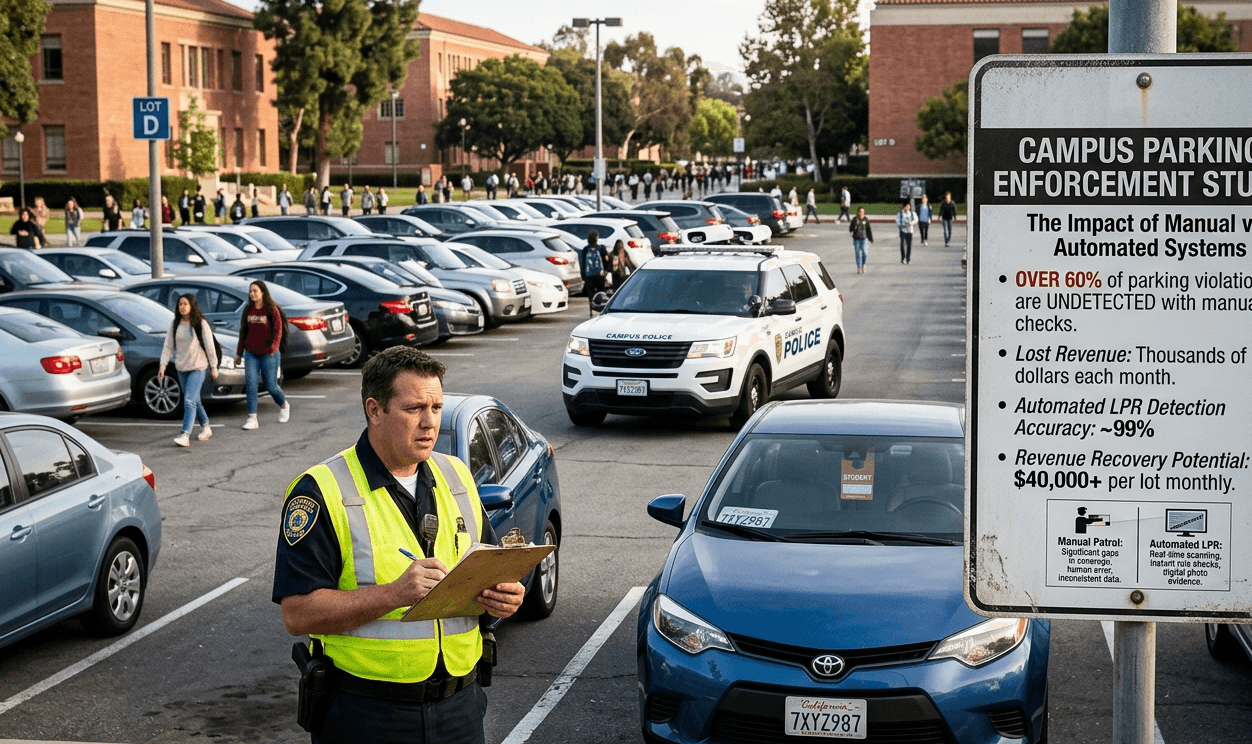
Over 60% of campus parking violations go undetected, costing universities thousands in lost revenue each month while undermining compliance across campus.
Campus parking directors face a persistent challenge: traditional enforcement methods miss most violations, creating a cascade of operational and financial problems. Manual patrols, clipboard-based workflows, and inconsistent coverage leave money on the table while eroding student and staff trust in parking policies.
Automated parking enforcement powered by License Plate Recognition (LPR) technology offers a proven solution, helping universities capture missed revenue, improve compliance, and create safer campus environments.
Universities lose significant revenue when violations go undetected. Research indicates that over 60% of campus parking violations slip through traditional enforcement systems, representing tens of thousands of dollars in uncaptured citation revenue each month.
The financial impact extends beyond immediate lost citations:
| Impact area | Manual enforcement | Automated enforcement |
|---|---|---|
| Detection rate | ~40% of violations | ~99% detection accuracy |
| Revenue capture | Significant losses monthly | Recovery of $40,000+ per lot |
| Staff efficiency | Hours of patrol coverage | Monitor multiple lots simultaneously |
| Appeal disputes | He-said-she-said evidence | Timestamped photo documentation |
Even well-staffed parking operations struggle with manual enforcement limitations:
Officers can physically patrol only a small portion of campus lots during any given shift. Large universities with dozens of lots and thousands of spaces face impossible coverage math — one officer cannot monitor every violation in real time.
Manual plate checks, handwritten citations, and subjective judgment calls lead to missed violations and disputed tickets. Officers may overlook expired permits, misread license plates, or struggle with complex time-based parking rules.
Appeals increase when citations lack clear evidence. Parking administrators spend valuable time reviewing disputes, often without definitive proof of the violation circumstances.
Universities may lose at least 60% of potential citation revenue when enforcement relies on manual patrols and spot checks alone.
LPR-based automated enforcement systems monitor every parking space continuously, detecting violations as they occur:
Automated enforcement addresses specific campus parking challenges:
Consistent enforcement creates predictable consequences for violations. When students know every space is monitored, permit compliance increases and unauthorized parking decreases.
Game days, graduation, and campus events create parking surges that overwhelm manual enforcement. Automated systems handle high-volume periods without additional staffing.
Universities typically see significant citation revenue increases — often recovering $40,000 or more per lot per month in previously missed violations. This revenue supports parking infrastructure improvements and campus transportation programs.
Unauthorized vehicles are flagged instantly, improving security response times. Real-time occupancy data helps emergency services navigate campus lots during incidents.
Automated parking enforcement can help universities recover up to 75% of previously missed citation revenue while reducing enforcement labor costs.
Universities evaluating automated enforcement should assess:
Modern camera-based systems deploy faster than per-space sensor installations, often going live within days rather than months of infrastructure work.
Modern LPR systems achieve ~99% plate recognition accuracy in typical parking lot conditions. False positives are rare, and every citation includes photo evidence for verification.
Automation typically redeploys officers to higher-value tasks like customer service, event management, and complex enforcement scenarios rather than eliminating positions.
Initial adjustment periods are common, but consistent, fair enforcement with clear evidence typically improves satisfaction with parking policies over time.
Yes — modern platforms support time-based restrictions, multiple permit types, visitor validation, and event-specific rules through cloud-based configuration.
Universities often see positive ROI within 6-12 months through increased citation revenue and reduced labor costs, with ongoing benefits from improved compliance.
Automated parking enforcement represents the foundation for comprehensive smart campus initiatives. Universities that implement LPR-based systems often expand to include:
The shift from reactive, manual enforcement to proactive, automated compliance creates measurable improvements in revenue, safety, and campus experience — positioning universities for future transportation and mobility challenges.
Learn more about automated parking enforcement solutions for universities or explore the potential ROI for your campus with our parking enforcement calculator.