
Loading article…
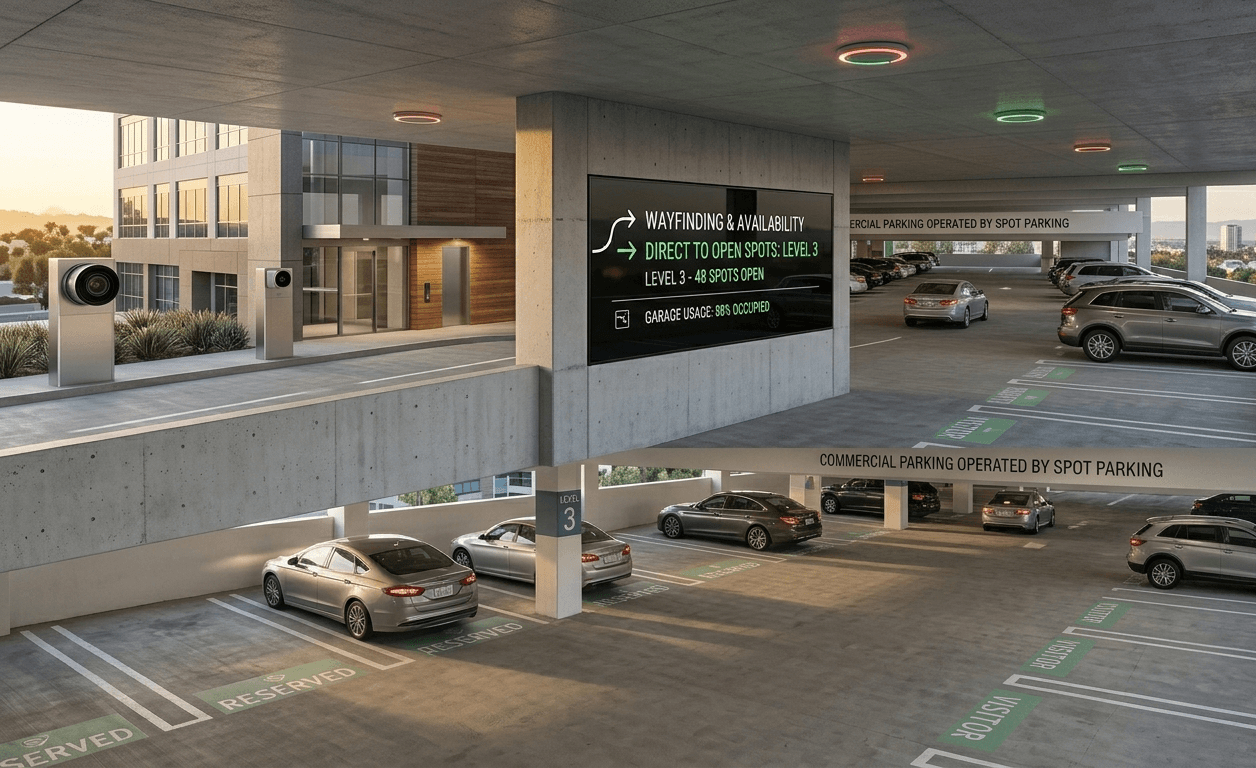
How commercial property owners are leveraging AI cameras, automated enforcement, and real-time wayfinding to protect tenant retention and unlock hidden asset value.
Published October 1, 2025
For many commercial properties, parking is the first impression — and too often, it's a bad one.
Commercial parking shouldn't be the source of daily frustration for tenants, visitors, and property managers. Yet most commercial properties still rely on outdated systems that create stress instead of efficiency. Whether it's tenants frustrated by full lots, visitors confused by unclear signage, or managers struggling with inconsistent enforcement, traditional parking creates problems that smart technology can solve.
Most commercial properties operate with manual systems that can't keep pace with modern demand. These outdated approaches create a cascade of operational problems:
| Problem | Impact on operations | Cost to property |
|---|---|---|
| Wasted search time | Drivers circle endlessly looking for spots | Lost productivity, tenant complaints |
| Inefficient space use | Empty spots go unused while others stay overpacked | Reduced effective capacity |
| Weak security | Unauthorized vehicles slip through unnoticed | Tenant safety concerns, liability |
| High enforcement costs | Manual patrols drain time and resources | Labor overhead, inconsistent coverage |
| Low satisfaction | Tenants and visitors start their day frustrated | Reputation damage, tenant turnover |
When parking causes delays or confusion, it ripples through the entire property — affecting both reputation and revenue for commercial property owners.
Late employees miss meetings. Frustrated customers leave before shopping. Delivery drivers waste time searching for loading zones. These small parking frustrations compound into measurable financial losses through reduced productivity, tenant complaints, and negative first impressions.
Manual enforcement creates gaps where unauthorized vehicles occupy tenant spaces for hours or days. Without real-time monitoring, property managers often discover security issues only after tenants complain — too late to prevent the problem.
Modern parking platforms like Spot Parking use AI-powered cameras, real-time wayfinding, and automated enforcement to transform chaotic lots into efficient operations.
Smart cameras monitor every space continuously, feeding live occupancy data to mobile apps and digital signage. Drivers receive turn-by-turn directions to available spots, eliminating the circling that creates congestion and delays.
License Plate Recognition (LPR) cameras detect violations as they happen — unauthorized vehicles, expired sessions, and permit violations. Citations are issued automatically with timestamped photo evidence, reducing enforcement labor by up to 75% while improving compliance.
Every vehicle entry and exit is logged with plate data and timestamps. Unauthorized vehicles are flagged immediately, and property managers receive alerts for security incidents or policy violations.
Property owners gain access to occupancy analytics, peak usage patterns, and space utilization reports. This data reveals opportunities to adjust pricing, reallocate spaces, or plan capacity expansions based on actual demand.
Smart parking delivers measurable benefits across different commercial property types:
Smart parking systems typically pay for themselves through:
Most camera-based systems can be installed and operational within days to weeks, depending on lot size and infrastructure requirements. Unlike sensor-based solutions, camera systems require minimal ground work and can adapt to existing lot layouts.
Smart parking platforms include redundancy and backup systems. During maintenance, properties can fall back to traditional enforcement methods while retaining access to historical data and analytics.
Every citation includes timestamped photo evidence and plate data, making appeals straightforward to review. Property managers can approve or reject disputes based on clear visual evidence rather than he-said-she-said scenarios.
Modern platforms offer APIs and integrations with common property management, access control, and payment systems. This allows parking data to flow into existing operational dashboards and tenant portals.
Commercial parking LPR systems are designed for operational use only. Plate data is encrypted, access is restricted to authorized personnel, and retention policies ensure data is not stored longer than necessary for parking operations.
Commercial parking doesn't have to be a daily source of frustration. Smart parking technology transforms lots from operational headaches into strategic advantages — improving tenant satisfaction, reducing costs, and enhancing property value. For commercial property owners ready to modernize their parking operations, platforms like Spot Parking offer the tools to turn parking problems into competitive advantages.