
Loading article…
Published August 6, 2025
Just as governments cannot maximize revenue by endlessly raising taxes, parking programs cannot maximize compliance and revenue by endlessly raising fines or increasing enforcement intensity.
Parking administrators face a fundamental challenge: how aggressive should enforcement be? Set fines too low or enforce sporadically, and violations multiply while revenue suffers. Push too hard with excessive penalties or over-aggressive patrols, and you risk backlash, reduced permit sales, and drivers avoiding your facilities altogether.
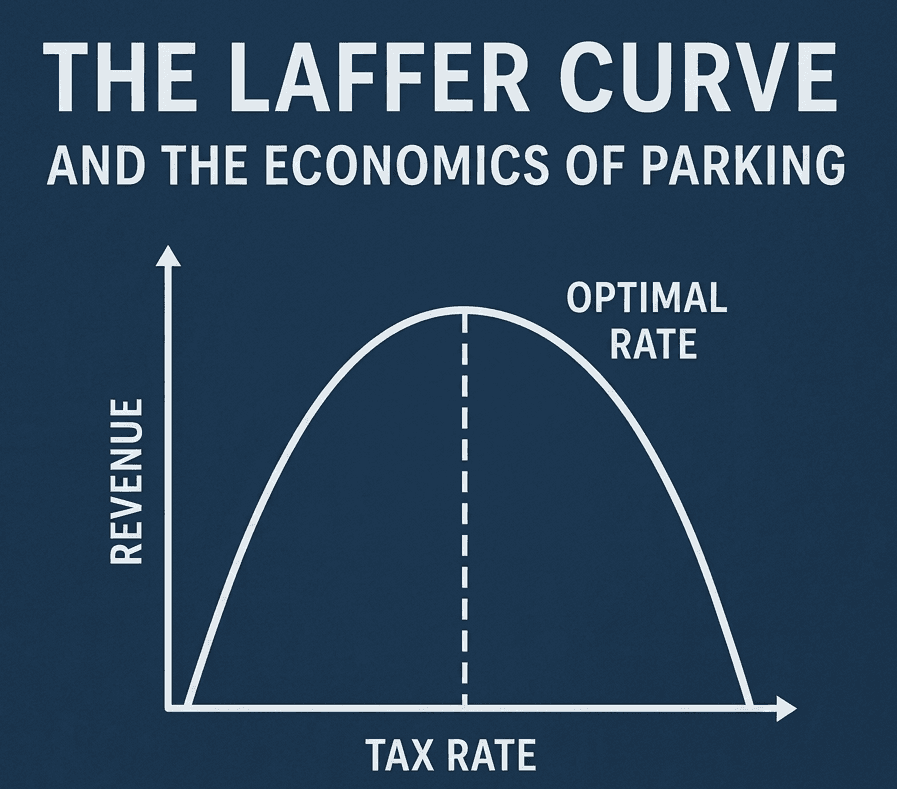
The answer lies in economic theory — specifically, the Laffer Curve. This principle shows why finding the optimal balance between enforcement intensity and fine levels is crucial for sustainable parking operations that maximize both compliance and revenue.
The Laffer Curve, developed by economist Arthur Laffer, illustrates a simple but powerful concept: raising tax rates does not always increase government revenue. The relationship between tax rates and total collections follows an inverted U-shape, with an optimal point where revenue peaks.
Here's how it works:
This same principle applies directly to parking enforcement economics.
Parking revenue can be expressed through this relationship:
R = p × f × v
Where:
As enforcement probability increases, violation volume typically decreases because drivers comply more often. This creates the same inverted-U relationship as the Laffer Curve — and reveals why more enforcement doesn't always mean more revenue.
| Enforcement Level | Violation Volume | Revenue Collection | Compliance |
|---|---|---|---|
| Very low | High | Low (few caught) | Poor |
| Moderate | Medium | High (optimal balance) | Good |
| Very high | Low | Low (few violations to cite) | Excellent |
When enforcement is sporadic or fines are minimal, drivers quickly learn they can park illegally with little consequence. This leads to:
Universities often see this pattern when relying purely on manual patrols that cover each lot only once or twice per day.
Overly aggressive enforcement or punitive fines can damage the relationship between parking operations and their community:
Case study insight: Universities with fines above $75 for standard violations often see diminishing returns as students and staff seek off-campus alternatives, reducing overall parking program revenue.
Modern parking technology enables administrators to identify their revenue optimization point through real-time analytics:
Compliance metrics to track:
Warning signs you're below the optimal point:
Warning signs you're above the optimal point:
Successful parking programs typically find their sweet spot within these ranges:
| Metric | Optimal Range |
|---|---|
| Violation detection rate | 85-95% of actual violations |
| Fine levels | $25-50 for standard violations |
| Enforcement frequency | Every 2-4 hours in high-turnover areas |
| Compliance rate | 90-95% during peak periods |
Automated enforcement systems help parking operations maintain consistent pressure without the labor costs of constant manual patrols. License plate recognition (LPR) cameras enable:
This technology helps administrators find and maintain their optimal enforcement point by providing the data needed to adjust fine levels and enforcement intensity based on actual compliance patterns.
Campus parking faces unique seasonal challenges — from semester surge to event parking. The Laffer Curve principle helps administrators:
University parking solutions must account for the community relationship alongside revenue optimization.
Office buildings and retail centers need enforcement that supports tenant satisfaction while controlling costs:
Hospitality parking requires balancing guest experience with operational efficiency:
Monitor your compliance rate and revenue trends together. If compliance is very high (95%+) but revenue is declining, fines may be too aggressive. If compliance is poor (below 85%) despite enforcement, fines may be too low to change behavior.
High-turnover areas (retail, airports) typically need enforcement every 1-2 hours. Lower-turnover areas (employee lots, residential) may only need 2-3 checks per day. The key is consistency rather than frequency.
Automated enforcement increases the probability (p) in the revenue formula while reducing costs. This typically shifts the optimal point toward higher compliance and more sustainable revenue, as the cost of maintaining consistent enforcement drops significantly.
No — different lot types serve different user groups with varying price sensitivity. Employee lots may tolerate higher enforcement intensity, while visitor lots may need gentler approaches to avoid deterring customers.
Transparency helps. Share compliance data showing how enforcement ensures space availability for permit holders and paying customers. Consider graduated enforcement policies that provide warnings before citations for first-time violators.
The Laffer Curve teaches us that optimization requires balance, not extremes. Successful parking programs find the sweet spot where enforcement is consistent enough to ensure compliance but fair enough to maintain community trust and participation.
Modern parking technology makes this balance easier to achieve and maintain by providing the data needed to adjust enforcement intensity and fine levels based on actual behavior patterns rather than guesswork.
Ready to optimize your parking enforcement strategy? Calculate your potential ROI with balanced enforcement that maximizes both revenue and compliance.