
Loading article…
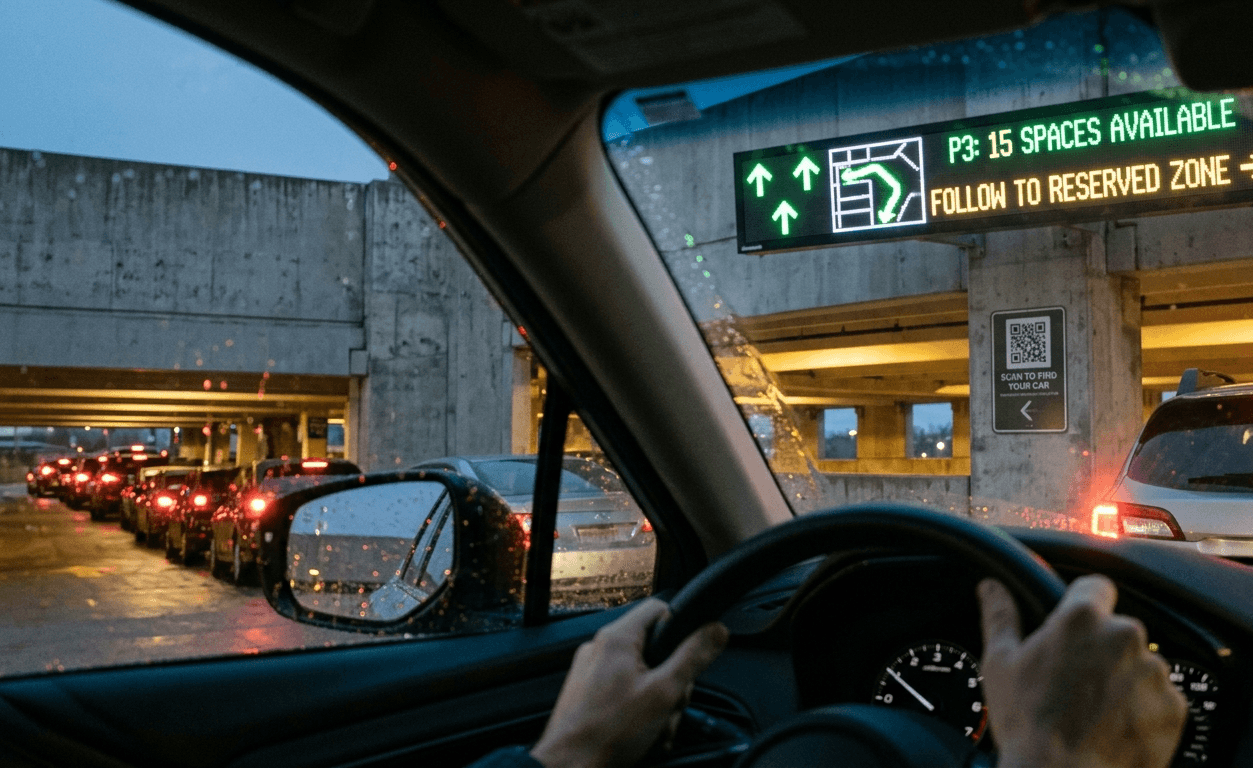
From stressful circling to seamless arrival: How AI-powered navigation and digital touchpoints are taking the guesswork out of the modern parking journey.
Published October 9, 2025
For decades, parking has been a necessary frustration — circling crowded lots, guessing where to go, and hoping to find a space before you're late. But today, innovation is changing the game.
Smart wayfinding systems are transforming one of the most stressful parts of any trip into a smooth, predictable experience. From airports to universities to commercial properties, AI-powered navigation is eliminating the guesswork and reducing the time drivers spend searching for parking.
Traditional parking depends on static signage, limited visibility, and driver intuition. During busy hours, this creates a cascade of operational problems:
| Challenge | Impact on Operations | Impact on Visitors |
|---|---|---|
| Limited visibility | Underutilized remote spaces | Wasted time circling preferred areas |
| Static signage | No real-time capacity updates | Drivers enter full lots anyway |
| Guesswork navigation | Traffic bottlenecks at entrances | Stress and potential lateness |
| No guidance to spaces | Uneven lot utilization | Frustration with the parking experience |
Studies show that drivers can spend up to 40% longer searching for parking in lots without real-time guidance systems.
Whether at an airport during peak travel, a university during class changes, or a commercial property during business hours, the result is the same: inefficiency, congestion, and frustrated visitors who associate parking problems with the destination itself.
Modern wayfinding systems use AI-powered cameras, live occupancy data, and digital guidance to direct drivers straight to available spaces. The technology creates a connected ecosystem that eliminates uncertainty:
Forward-thinking properties are already seeing the benefits of connected wayfinding systems. At universities, students can scan QR codes posted around campus to get directions to the nearest available parking. Hotels use the same technology to guide guests directly to their reserved spaces or the closest available spot.
Smart wayfinding doesn't stop when you park. The same system that guided you to your space can help you find your parked car later — no more wandering around multi-level garages or sprawling surface lots trying to remember where you left your vehicle.
Platforms like Spot Parking's wayfinding solution integrate space detection, routing, and vehicle location into one seamless experience that works across web, mobile, and on-property signage.
The shift toward intelligent parking navigation delivers measurable benefits for both operators and visitors:
When drivers spend less time circling, carbon emissions drop significantly. A university that reduces average search time by just 3 minutes per visitor can prevent thousands of pounds of CO2 emissions annually.
Parking sets the tone for any visit. When parking feels effortless, people arrive calmer, on time, and with a positive first impression of the destination.
Properties with smart wayfinding report up to 60% fewer parking-related complaints and customer service inquiries.
| Industry | Primary wayfinding benefits |
|---|---|
| Universities | Reduce late arrivals, manage semester surge, improve campus experience |
| Airports | Minimize pre-flight stress, optimize lot utilization, reduce terminal congestion |
| Hotels & resorts | Enhance arrival experience, streamline valet operations, support event parking |
| Commercial properties | Improve tenant satisfaction, maximize revenue per space, reduce traffic complaints |
| Healthcare facilities | Reduce patient stress, support emergency access, manage visitor peaks |
As technology evolves, the next wave of innovation will make parking even more personalized and predictive:
AI will predict parking demand based on events, weather, historical patterns, and real-time city data. Lots will adjust pricing and routing proactively rather than reactively.
Integration with calendar apps and navigation systems will let drivers reserve spaces automatically based on their destination and arrival time.
Connected cars will communicate directly with parking systems, receiving space assignments before arrival and automatic payment processing upon departure.
The ultimate goal is wayfinding so intuitive that drivers barely notice it — spaces appear available exactly when and where needed, with guidance that feels natural rather than technological.
Modern camera-based systems achieve over 99% accuracy in detecting space availability, even in challenging conditions like low light or weather. The technology continuously improves through machine learning.
Smart wayfinding systems use multiple channels — QR codes work through any camera app, digital signs provide backup guidance, and the underlying space detection continues operating regardless of individual device connectivity.
Yes, modern platforms are designed to work with existing payment systems, access control, and enforcement tools. The wayfinding layer adds intelligence without requiring infrastructure replacement.
Properties typically see 30-40% reductions in average search time, with some reporting that guided drivers find spaces up to 3x faster than those navigating manually.
Smart systems excel during high-demand periods by distributing traffic across all available areas and providing real-time updates as spaces fill. Event-specific routing can direct different visitor types to designated zones.
Smart wayfinding represents more than a technological upgrade — it's a fundamental shift toward parking that works with drivers instead of against them. As properties adopt these systems, the benefits compound: happier visitors, more efficient operations, and sustainable traffic patterns that support growth rather than creating bottlenecks.
The future of parking is already arriving at forward-thinking properties. The question isn't whether smart wayfinding will become standard, but how quickly operators will embrace the competitive advantage it provides.
Explore Spot Parking's wayfinding solutions to see how real-time guidance can transform your parking operations.