
Loading article…
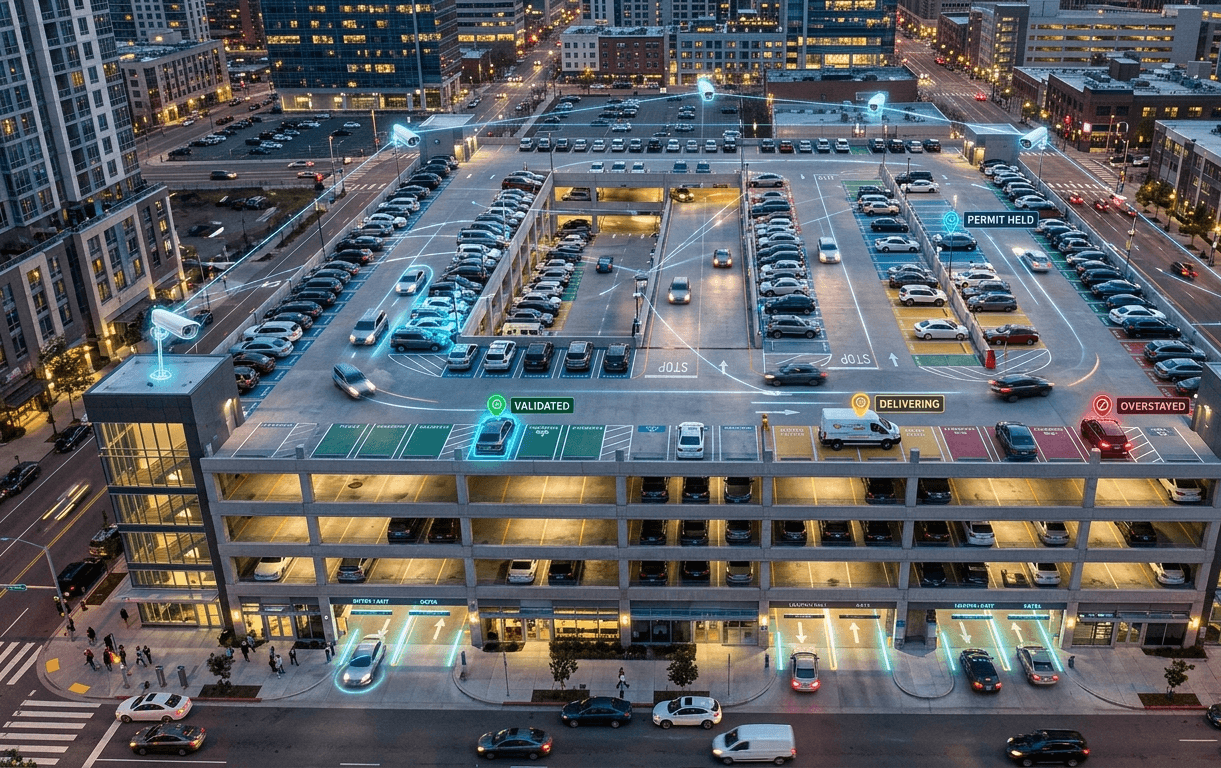
The Future of Parking Is Not Just Entry and Exit. It Is Knowing What Happens After the Vehicle Arrives.
Published June 30, 2026
For years, parking technology has been built around one basic question: Did the vehicle enter, and did the vehicle leave?
That works for traditional gated facilities. It works for simple transient parking. It works when the only thing you need to know is whether a license plate crossed a lane.
But modern parking operations are no longer that simple.
Operators, hotels, universities, mixed-use properties, retail centers, airports, venues, and residential communities are dealing with more complexity than ever before. They are managing permits, guests and vendors, validations, reserved spaces, ADA abuse prevention, overnight parking, retail visits, enforcement disputes, payment compliance, wayfinding, and multi-location operations.
Entry and exit data alone does not solve that. It tells you a vehicle came in. It does not tell you where it went, whether it parked, whether it was allowed to park there, whether it overstayed, whether it validated correctly, or whether it belonged to a resident, guest, employee, tenant, customer, vendor, or visitor.
That is where Spot Parking is different.
Spot Parking is built to track what actually happens inside the parking operation — not just the gate, entrance, or exit, but the full parking journey.
Most parking problems happen after a vehicle enters the property. A guest parks in the wrong area. A resident's visitor overstays. A retail customer claims they were validated. A hotel guest checks out without paying. A vendor parks in a restricted area. A vehicle moves between lots or levels. A parker says they "never parked there." A permit holder abuses access across multiple locations.
Traditional LPR systems often miss this because they are focused on access points. They capture a plate at entry and exit, then assume everything in between.
Spot Parking gives operators a smarter layer of visibility. Instead of relying only on entry and exit timestamps, Spot helps identify where vehicles are, how they move, when they park, and whether their activity matches the rules of the location.
Real enforcement is not about catching people after the fact — it is about understanding activity in real time.
A lot of parking technology projects become expensive because the answer is always more hardware: more LPR lanes, more cameras, more trenching, more conduit, more servers, more infrastructure, more installation cost.
Spot Parking challenges that model. By combining LPR, aerial camera visibility, vehicle tracking, rules automation, and parking intelligence, Spot can help locations get more coverage with less hardware than traditional approaches.
The result: lower upfront cost, faster deployment, and fewer installation headaches. For operators, that can be the difference between a project that gets approved and a project that gets delayed for another budget cycle.
Spot is not designed to make parking operations more complicated — it is designed to make complex operations easier to manage.
One of the biggest problems in parking enforcement is trust. When a parker receives a notice, they often ask: "How do you know I parked there?" or "What if I just drove through?" or "What if I entered but never parked?" or "What if I paid, but the system did not connect it?" or "What if I was a hotel guest, tenant, or validated customer?"
Those are fair questions. And they are exactly why enforcement needs better context.
Entry-only or entry-exit-only enforcement can create disputes because it does not always prove what happened inside the facility. Spot Parking is built around the idea that enforcement should be tied to actual parking activity, not assumptions.
That means operators can create smarter rules around when a violation should happen, when it should not happen, and when another system or workflow should override enforcement.
In a hotel environment, an overnight guest should not automatically receive a ticket just because they parked. The system should understand the guest journey. If the guest checks out and the parking was not paid or validated, then enforcement can happen after the proper logic is applied. That is a better experience for the guest and better protection for the operator.
Permit parking is one of the most underestimated problems in the industry. A simple permit program is easy, but real operations are rarely simple.
You may have residents, employees, students, faculty, tenants, contractors, vendors, guests, VIPs, and ADA users sharing reserved spaces with time-based and location-based permissions, event overrides, validation rules, visitor limits, and different enforcement policies across multiple lots or garages. Some properties have dozens of rules across many locations.
The problem is not that permit parking is too complex — the problem is that most systems are not built to handle complexity.
Spot Parking gives operators more control over rules, permissions, visibility, and enforcement logic. Instead of forcing the operation to fit the software, Spot is designed to help the software fit the operation. That matters for universities, hotels, mixed-use properties, residential communities, and commercial operators where one-size-fits-all enforcement simply does not work.
Validation is another area where parking operations often lose control. A restaurant wants to validate customers. A hotel wants to validate guests. A retailer wants to cover the first hour. A merchant wants to reward repeat visits. A printed receipt needs to override an existing session. A validation needs to apply even if the parking session has already started. A discount may need to apply after the fact.
If validation tools are too rigid, staff create workarounds. Those workarounds create leakage, disputes, and manual reconciliation.
Spot Parking supports the idea that validations should be flexible enough to match the real business rules of the property. The goal is simple: make it easy for legitimate parkers to be validated, make it hard for people to abuse the system, and give operators the visibility to know the difference.
A parking app helps someone pay. Spot Parking does more than that.
Spot connects the parking experience across visibility, payment, enforcement, navigation, analytics, permits, validations, and operational control. A parker can drive in, be recognized, be guided, pay, validate, or be managed through the correct rule set. An operator can see what is happening across the location, identify compliance issues, reduce manual patrol, support enforcement, and improve revenue capture.
That is the difference between a payment tool and a parking intelligence platform.
Every parking location is different. A hotel does not operate like a university. A university does not operate like a retail center. A retail center does not operate like a stadium. A stadium does not operate like an airport. A residential garage does not operate like a transient surface lot.
That is why Spot Parking is built to be flexible. It can support operators that want to modernize enforcement, properties that need better visibility, hotels managing overnight guests and validations, mixed-use sites with residents, retail, and visitors, universities with complex permit rules, and operators that need analytics without ripping out every existing system on day one.
Spot is not about adding technology for the sake of technology. It is about giving parking teams control: control over compliance, control over revenue, control over rules, control over the parker experience, control over enforcement, and control over what is actually happening on the property.
The next generation of parking will not be defined by who can capture a plate at the entrance. It will be defined by who can understand the full parking journey.
Where did the vehicle go? Did it park? Was it allowed to park there? Did it pay? Was it validated? Did it overstay? Did it violate a rule? Should enforcement happen now, later, or not at all? Can the operator prove it?
That is the future Spot Parking is building toward — a smarter, more flexible, more visible parking operation. One that helps operators reduce hardware costs, improve compliance, increase revenue capture, reduce disputes, and create a better experience for every parker
Because parking does not end when a vehicle enters.
That is where the real operation begins.