
Loading article…
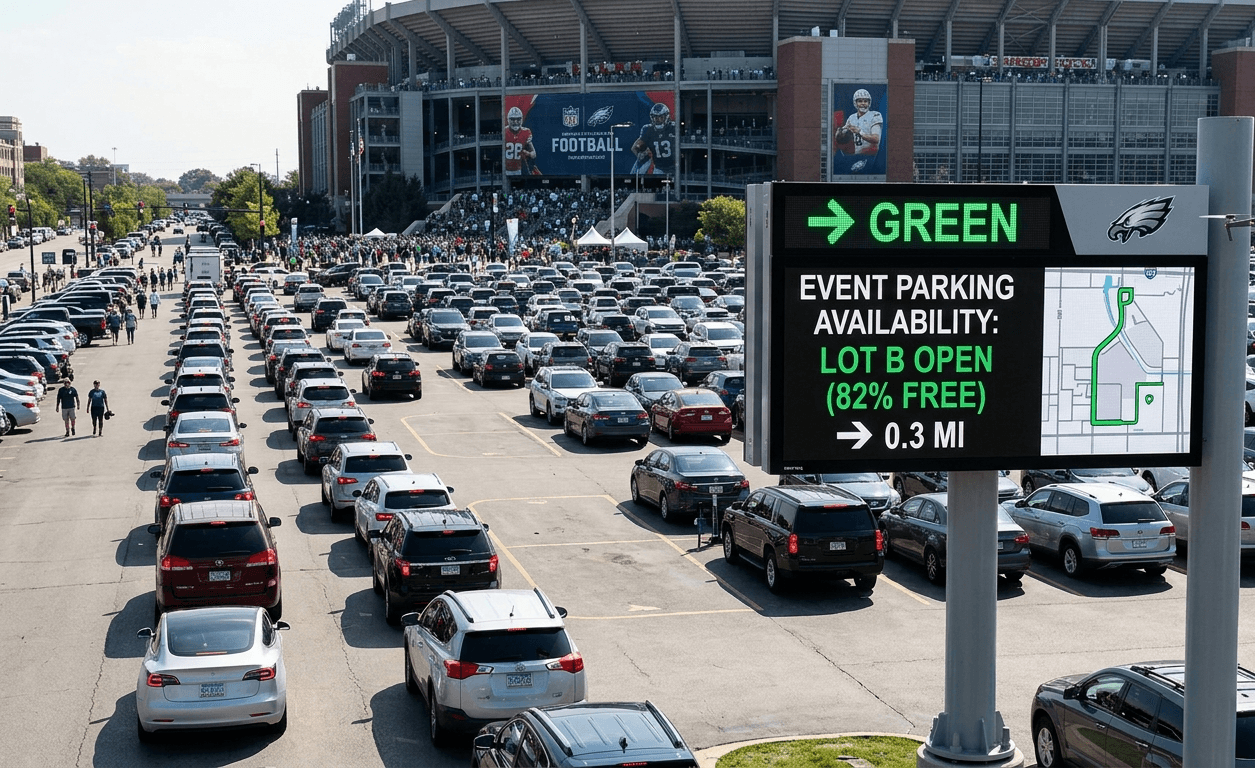
From the frustration of circling the lot to seamless arrival: How real-time wayfinding is eliminating the hidden costs of event-day traffic congestion.
Published January 9, 2026
You're on your way to a football game. You planned ahead, left early, and even built in a 20-minute buffer before kickoff. It should be enough. Then you reach the parking lot.
You're on your way to a football game. You planned ahead, left early, and even built in a 20-minute buffer before kickoff. It should be enough.
Then you reach the parking lot.
Cars idle in tight loops. Drivers inch forward, scanning for brake lights that might signal an opening. Every space appears taken. Minutes pass. What began as a minor delay turns into something more familiar: a slow, creeping realization that you will not make it on time.
Eventually, you abandon the lot and try the surrounding streets. After another stretch of searching, you settle for a spot well outside the venue, far enough that the walk back feels like part of the journey itself. By the time you arrive, the game has already begun.
For many drivers, this is less of a one-off and more of a routine inconvenience.
The modern parking experience, particularly around large events, remains surprisingly analog. Despite advances in navigation, payments, and mobility services, the act of finding a parking space still depends largely on chance and persistence. Drivers circle, wait, and guess. Lots fill unevenly. Restrictions are unclear. The result is a quiet but significant inefficiency measured not only in time and fuel, but in missed moments.
What makes the problem more frustrating is its predictability. Congestion around stadiums, concert venues, and city centers follows patterns, yet the tools available to manage it often lag behind. Parking security, even at its best, struggles when faced with such loads. Static signage and basic monitoring systems can't reflect real-time conditions, especially as crowd sizes fluctuate.
Event parking creates a cascade of inefficiencies that extend far beyond individual frustration:
Event venues can lose up to 15% of potential revenue when parking delays cause attendees to miss opening segments or abandon their plans entirely.
The gap between what drivers need and what infrastructure provides has only widened as event attendance has grown while parking management has remained largely unchanged.
A new generation of parking technology aims to close that gap by treating parking not as a fixed resource, but as a dynamic system that responds to real-time conditions.
Spot Parking represents this approach through AI-powered monitoring that transforms how venues manage parking flow. Built on computer vision and real-time data processing, the platform monitors parking lots through a network of cameras and software that track usage moment by moment.
Rather than relying on estimates or outdated counts, the system identifies where vehicles are parked, where space remains available, and how conditions are changing in real time. For drivers, the experience becomes less about searching and more about navigating with confidence.
The system can also distinguish between permitted and restricted areas, helping users avoid common pitfalls that lead to tickets or towing. Wayfinding technology reduces the friction at a point in the parking journey that has long been taken for granted.
For venue operators, the implications extend beyond convenience. Large events bring surges of traffic that can overwhelm even well-designed facilities. Managing that influx typically requires a combination of staffing, planning, and improvisation.
Smart parking systems introduce a layer of adaptability that transforms operations:
| Traditional approach | Smart parking approach |
|---|---|
| Static lot assignments | Dynamic load balancing across zones |
| Manual traffic direction | Data-driven routing decisions |
| Reactive problem solving | Predictive capacity management |
| Limited visibility into utilization | Real-time occupancy across all areas |
By tracking how lots fill in real time, operators gain clearer visibility into capacity and flow patterns. That insight allows for more informed decisions — redirecting traffic, balancing usage across multiple areas, and responding to unexpected spikes as they occur.
Resorts and hotels can use occupancy forecasting to prepare for check-in rushes and special events. Universities can manage game day parking across campus while maintaining permit compliance for regular operations. Airports can balance short-term and long-term lot usage to optimize revenue and traveler convenience.
The goal shifts from simply filling spaces to managing them efficiently, reducing bottlenecks while improving the overall attendee experience.
Parking has long been treated as an unavoidable inconvenience — a final hurdle before reaching the destination. Yet it's increasingly clear that this friction is not inevitable.
As real-time systems become more common, finding a parking space may begin to resemble other aspects of modern travel: predictable, guided, and largely invisible. The driver's role shifts from hunter to participant in a system that already understands where capacity exists.
When parking becomes frictionless, the benefits extend throughout the entire event experience:
For anyone who has spent an hour circling a crowded lot, the appeal is immediate. The next time you head to a game or event, the question may no longer be where you will park, but whether you will need to search at all.
Modern camera-based systems achieve approximately 99% detection accuracy, providing reliable space availability data that updates within seconds of changes.
Yes, mobile camera systems can be deployed for festivals, outdoor concerts, and pop-up events, providing the same real-time guidance without permanent infrastructure.
Smart parking platforms include backup systems and can operate in degraded modes, reverting to traditional signage while maintaining core functionality through redundant connections.
Most platforms offer APIs and integrations with ticketing systems, mobile apps, and facility management tools, allowing venues to incorporate parking data into their existing workflows.
Camera-based systems are designed to function in various lighting conditions and can monitor multi-level garages, providing floor-by-floor availability and routing guidance.
The transformation of parking from a source of frustration to a seamless experience represents more than technological progress — it reflects a fundamental shift in how we approach urban mobility and event management.
As venues adopt real-time parking solutions, the benefits compound: attendees arrive relaxed and on time, operators gain unprecedented visibility into their facilities, and communities experience less traffic congestion around major events.
Ready to eliminate parking search time at your venue? Explore how Spot Parking's wayfinding solutions can transform your guest experience, or use our ROI calculator to estimate the impact for your specific operation.